
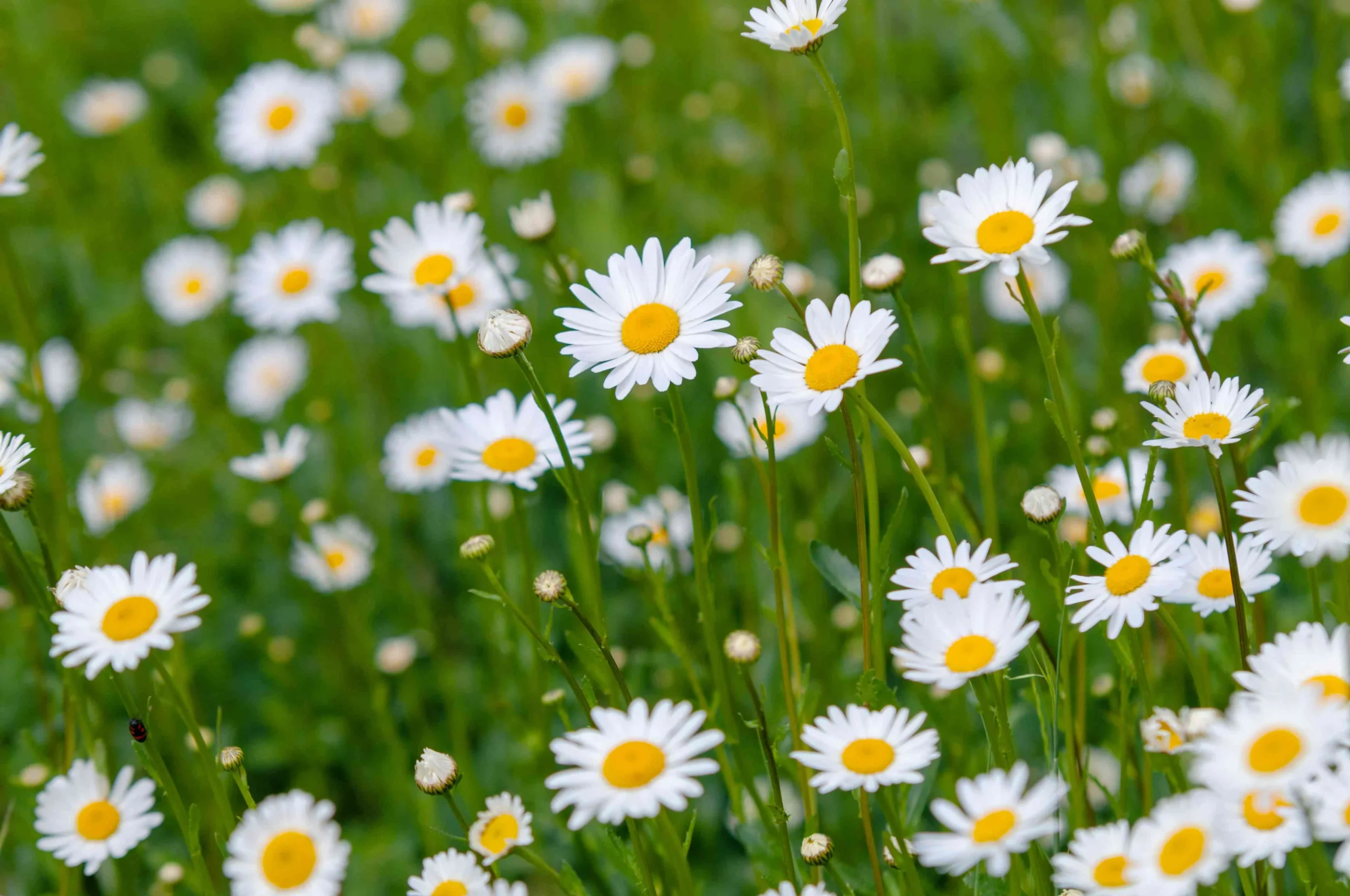
The daisy is one of the simplest yet most emotionally powerful flowers in nature because it represents purity, innocence, and natural beauty in its most minimal form, and unlike complex ornamental flowers that rely on dramatic shapes and strong fragrances, the daisy uses simplicity as its main survival and attraction strategy, where its clean white petals and bright yellow center create a visually balanced structure that appeals to both humans and pollinators, and this simplicity is not a weakness but actually a highly efficient evolutionary design that allows the daisy to thrive in diverse environments such as grasslands, meadows, and open fields across the world.
🌿 Botanical Structure and Natural Design of Daisy Plant
The daisy belongs to the family Asteraceae, one of the largest plant families in the world, and what makes daisies scientifically interesting is that what appears to be a single flower is actually a composite structure made up of hundreds of tiny flowers called florets, where the central yellow disc contains tubular florets responsible for reproduction, while the surrounding white “petals” are actually ray florets that function mainly to attract pollinators, and this structural design allows daisies to maximize reproductive efficiency while maintaining a simple outward appearance, making it a perfect example of how nature combines complexity and simplicity in a single biological system.
🌸 Why Daisy Looks So Simple but Works So Smart
The visual simplicity of the daisy is actually a highly advanced evolutionary strategy because its contrasting color pattern—white outer petals and a yellow center—creates a strong visual signal that is easily recognized by insects such as bees and butterflies, and this color contrast helps pollinators locate the flower quickly even from a distance, while the flat structure of the daisy allows easy landing access for insects, and scientifically speaking, this reduces energy consumption for pollinators while increasing pollination efficiency for the plant, showing that even the simplest-looking flowers can have highly optimized biological designs.
🌱 Life Cycle and Growth Pattern of Daisy
The life cycle of a daisy begins with seed germination in nutrient-rich soil, where the seed absorbs moisture and activates internal enzymes that trigger root formation followed by shoot growth, and as the plant develops, it forms a low-growing rosette of leaves close to the ground that helps protect it from harsh weather conditions, and once the plant reaches maturity, it produces flowering stems that rise upward and open into characteristic daisy blooms, and these flowers can continue blooming throughout favorable seasons, making daisies resilient plants that can survive repeated cutting, grazing, and environmental changes while still regenerating quickly due to their strong root systems.
🧠 Psychological Meaning and Emotional Impact of Daisies
Daisies have a strong psychological association with innocence, childhood memories, simplicity, and emotional purity because their visual design does not overwhelm the senses but instead creates a calm and balanced perception, and in color psychology, white is associated with peace and clarity while yellow represents happiness and optimism, so the combination of both colors in a daisy creates a natural emotional effect that promotes calmness and mental relaxation, which is why daisies are often used in gardens, decorations, and emotional symbolism to represent fresh beginnings and natural happiness.
🌍 Cultural and Symbolic Importance of Daisy Flower
Across different cultures, daisies symbolize purity, innocence, and loyal love, and in European traditions, daisies are often associated with childhood and simplicity, while in literature they are used as metaphors for honest emotions and natural beauty, and in modern culture daisies are widely used in weddings, gifts, and decorative arrangements to represent sincerity and emotional clarity, and because of their simple structure and universal presence in nature, daisies have become one of the most universally recognized symbolic flowers representing pure and unfiltered emotions.
🐝 Ecological Role and Importance in Nature
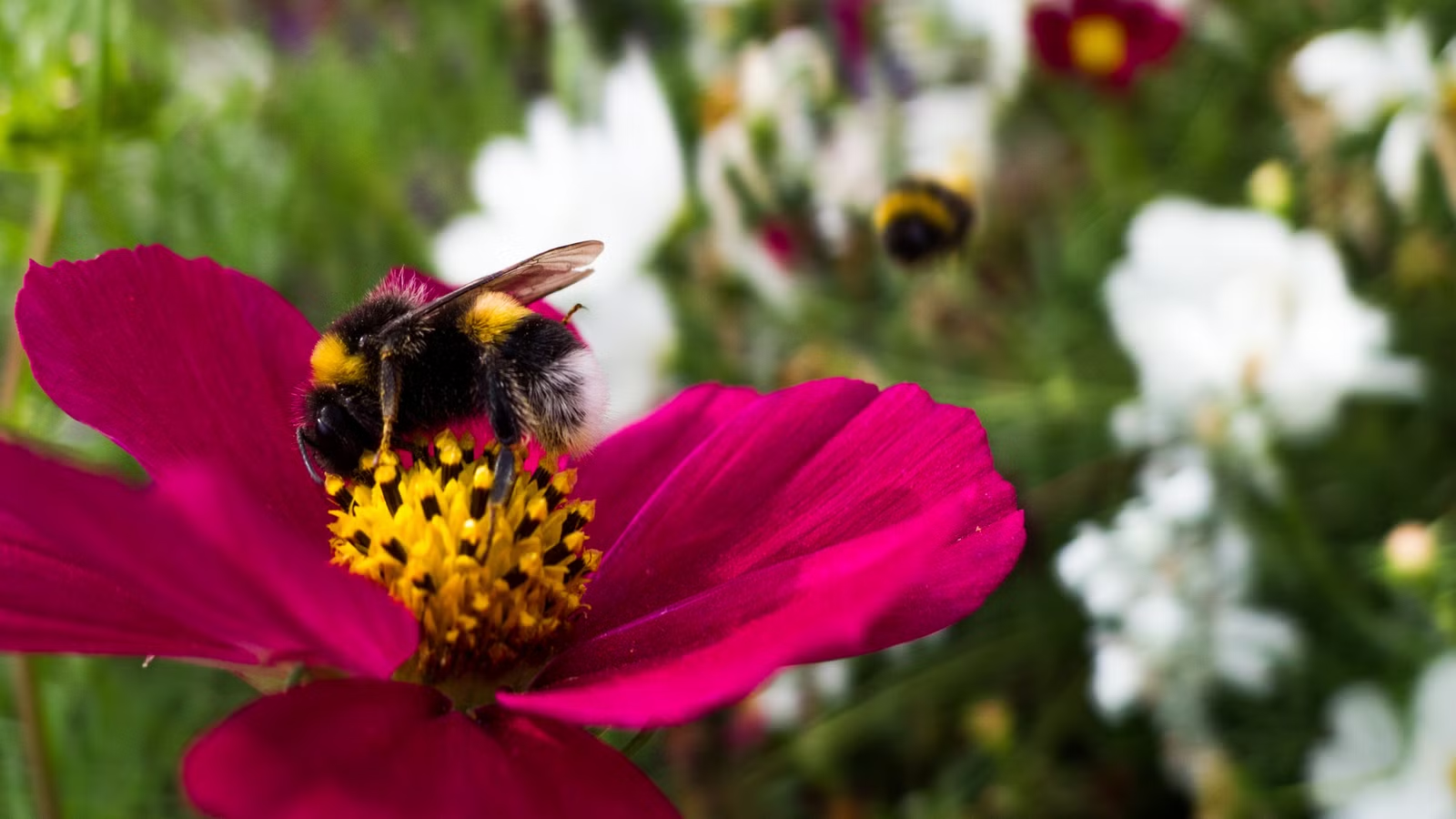
Daisies play an important ecological role by providing nectar and pollen to a wide range of pollinators, especially bees, butterflies, and hoverflies, and because they bloom in open fields and grasslands, they help support biodiversity in ecosystems where other food sources may be limited, and their ability to grow in disturbed soil also makes them important pioneer plants that help restore ecological balance in degraded environments, contributing to soil health, insect survival, and overall ecosystem stability.
🧪 Practical and Traditional Uses of Daisy
Although daisies are not as widely used in medicine or industry as plants like lavender or rose, they still have traditional uses in herbal remedies where extracts are sometimes used for mild skin treatments, wound healing, and anti-inflammatory purposes, and in some cultures daisies are also used in teas and natural preparations for soothing effects, while their main practical value today remains in ornamental gardening and ecological landscaping, where they are used to create natural-looking, low-maintenance green spaces.
🌸 Conclusion
The daisy is a perfect example of how nature achieves maximum beauty and efficiency through simplicity, because although it appears small and ordinary compared to exotic flowers, it carries a highly optimized biological structure, important ecological functions, and deep psychological and cultural meanings, and its ability to symbolize purity, innocence, and emotional clarity makes it one of the most universally loved flowers in the natural world, showing that true beauty in nature often comes from simplicity rather than complexity.
❓ FAQ
1. Why are daisies considered simple flowers?
Because of their minimal appearance, but biologically they are highly complex composite flowers.
2. What do daisies symbolize?
They symbolize innocence, purity, simplicity, and happiness.
3. Do daisies attract bees?
Yes, they are important nectar sources for bees and other pollinators.
4. Can daisies grow easily?
Yes, they are hardy plants that grow in many environments.
5. Are daisies useful for the environment?
Yes, they support pollinators and help maintain ecosystem balance.

Leave a Reply